Describe what was possible.
Recall a decision in its setting: the people, obligations, resources, and uncertainty around it. This provides a basis for examining how the situation developed.
The Life Direction Journals
The Life Direction Journals are designed so that reflection builds on what you have already written. You begin with particular experiences, keep a record, and return to it as other questions bring different parts of your life into view.
From experience to reflection
The circumstances of a choice can change how you judge it. What did you know then? What could you afford? Who else was involved? These details keep later judgments connected to the experience itself.
Recall a decision in its setting: the people, obligations, resources, and uncertainty around it. This provides a basis for examining how the situation developed.
What happened afterward can influence how you judge an earlier decision. Returning to the circumstances helps you consider what was chosen, what emerged later, and what you could not have known.
Earlier answers become material
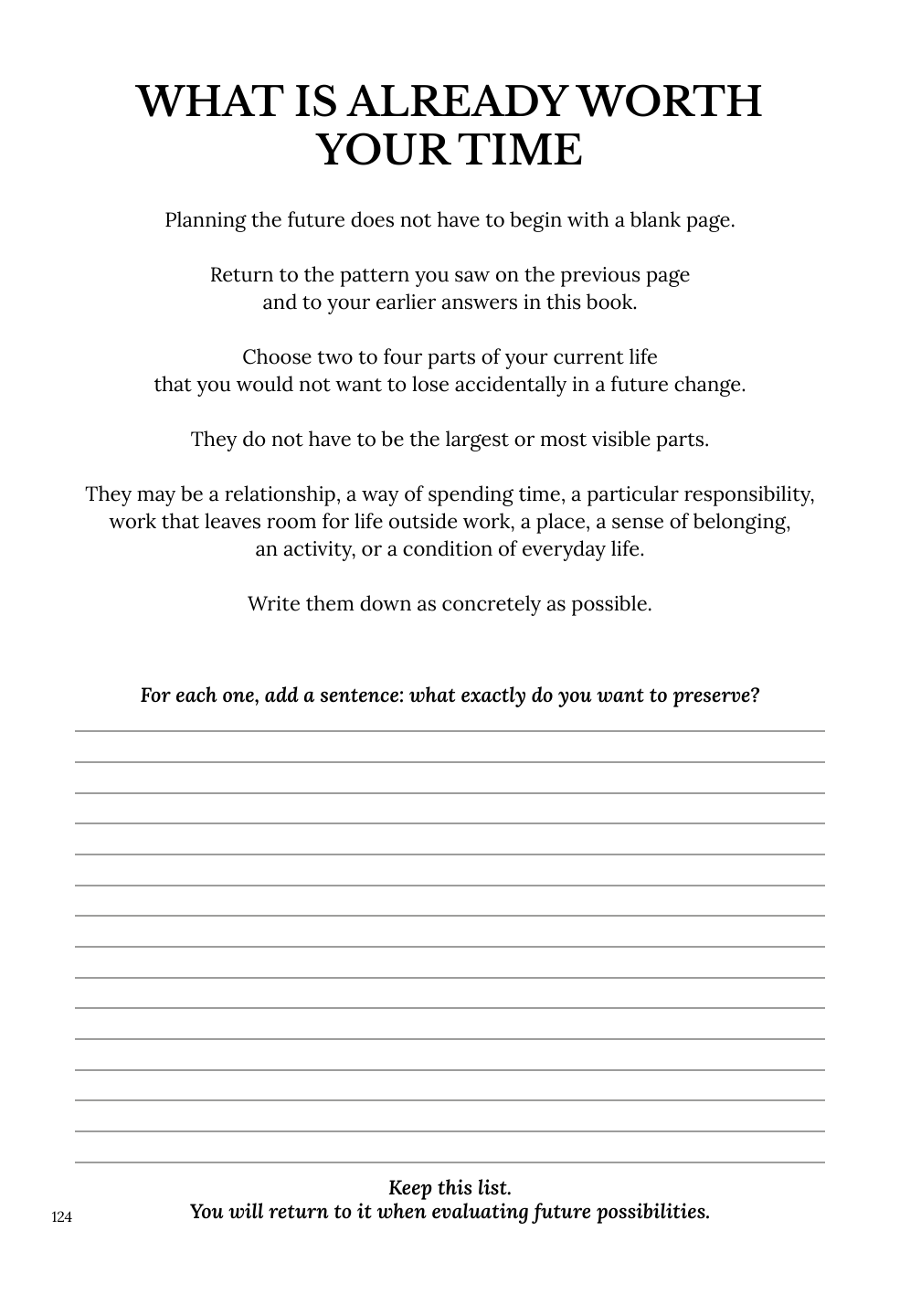
The value of an answer can change when it becomes part of another task. In 40s, PAGE 124 produces a record of what you want to preserve. PAGE 131 uses that record to examine a possible future.
On PAGE 124, you identify two to four parts of your present life that you do not want to lose in a future change, and specify what you want to preserve in each.
 View larger ↗
PAGE 131 asks you to bring that list to a future you are genuinely considering. You are now using the answer as a reference for judging a possibility. Consider what it would protect, weaken, or put in conflict.
An item on the list may turn out to depend on a person, place, or condition that this future would change. What began as a statement of importance now becomes a way to examine consequences and conflicts. You may understand the earlier answer differently in the process.
An example from 40s. These pages are separated by other reflections and do not form a physical spread.
PAGE 130 brings together earlier writing about energy, a future workweek, what you want to preserve, relationships, and home. It asks how those parts fit into one ordinary day five years from now.
→ PAGE 130 — An ordinary Tuesday five years from now
A direction that can be reconsidered
In 40s, a possible direction is followed by reflection on the answers that helped form it. Questions that did not fit, unresolved tensions, and things still unknown all remain relevant. Later experience can give you reason to assess the direction again.
One method, different stages of adult life
The series is built around returning to written answers and using them in later reflections. Each volume addresses a different problem within adult life, with a sequence designed for that task.
The first completed volume works with an accumulated life history to consider a direction for the current stage.
Explore 40sA different focus within adult life; details are still being developed.